Why Brisket Is Worth the Long Day
Brisket has a reputation as the final boss of barbecue, and honestly, the reputation is earned. It's a big, tough, expensive cut with two different muscles that want two different things, and it takes most of a day to cook. But here's the part the reputation leaves out: none of the individual steps are hard. Trim, season, hold a steady temperature, wait, wrap, wait some more, rest, slice. If you can follow a checklist and resist the urge to fiddle, you can make a genuinely good brisket on your first try.
This guide is the checklist. We've dug through the collective wisdom of pitmasters, competition cooks, and hundreds of first-timer post-mortems to build a playbook that assumes nothing and skips the mythology. Low and slow, salt and pepper, probe-tender, long rest. That's the whole religion.
Choosing Your Brisket: Packer vs. Flat
A whole packer brisket contains two muscles: the flat (lean, uniform, what deli slices come from) and the point (fattier, richer, where burnt ends come from), separated by a thick seam of fat. A flat-only brisket is just the lean half, usually 4–6 lbs.
Counterintuitively, we recommend the full packer for your first cook. The flat alone sounds beginner-friendly because it's smaller, but it's actually less forgiving: with less fat protecting it, a flat-only brisket dries out if you look at it wrong. The packer's point bastes the whole cut and gives you a margin for error. A 12–14 lb packer is the sweet spot.
At the store or butcher counter, look for:
- Choice grade or better. Prime has more marbling and more insurance; Select is a gamble not worth taking on a 12-hour cook.
- Flexibility. Pick the brisket up in the middle (still in its cryovac). The floppier it is, the more tender it'll cook.
- A thick, even flat. A flat that tapers to a thin edge will overcook at the tip no matter what you do.
Brisket Timeline at a Glance
Here's what a 12–14 lb packer looks like at 225–250°F. Treat every time below as an estimate: brisket is done when it's done, and two briskets of identical weight can finish hours apart.
| Stage | Target | Typical Time |
|---|---|---|
| Trim + season | Fat cap to ~1/4", salt + pepper | 45 min (night before) |
| Smoker preheat | Steady 225–250°F, clean smoke | 30–45 min |
| Unwrapped smoke | ~165°F internal, bark set | 6–8 hrs |
| The stall | Temp plateaus at 150–170°F | 2–5 hrs (inside the smoke) |
| Wrapped push | Probe-tender, ~203°F | 3–5 hrs |
| Rest | Wrapped, above 140°F | 1–4 hrs |
| Total | 12–18 hrs |
The working rule of thumb is 1 to 1.5 hours per pound at 250°F. Start earlier than you think you need to; a brisket that finishes early holds beautifully in a cooler, but a brisket that finishes late holds dinner hostage.
Trimming and Seasoning
Trim the brisket cold, straight from the fridge: cold fat cuts cleanly, warm fat smears. A flexible boning knife makes this dramatically easier than a chef's knife. You're doing four things:
- Trim the fat cap to about 1/4 inch. Enough to protect the meat, thin enough to render. Fat you leave beyond that just gets carved off at the table.
- Remove the hard deckle fat: the dense, waxy wedge between the point and flat. It never renders; take it out.
- Peel the silverskin and any large patches of fat off the meat side, so smoke and rub touch actual beef.
- Round off thin corners and edges. Anything thinner than about an inch will be jerky by hour ten.
The rub is Texas simplicity: equal parts by volume coarse kosher salt and 16-mesh coarse-ground black pepper, applied in one even layer on every surface. That's genuinely it. The coarse grind matters: fine table pepper turns bitter and cakes, while 16-mesh builds the pebbled black bark you're picturing. Add garlic powder if you must; skip sugary rubs, which burn over a 12-hour cook.
💡 Season the night before
Salt the brisket 8–12 hours ahead and leave it uncovered in the fridge. The salt migrates into the meat instead of sitting on top (effectively a dry brine), and the dried surface takes on smoke better and builds bark faster. If you're short on time, even one hour ahead beats seasoning at the smoker.
The Cook, Step by Step
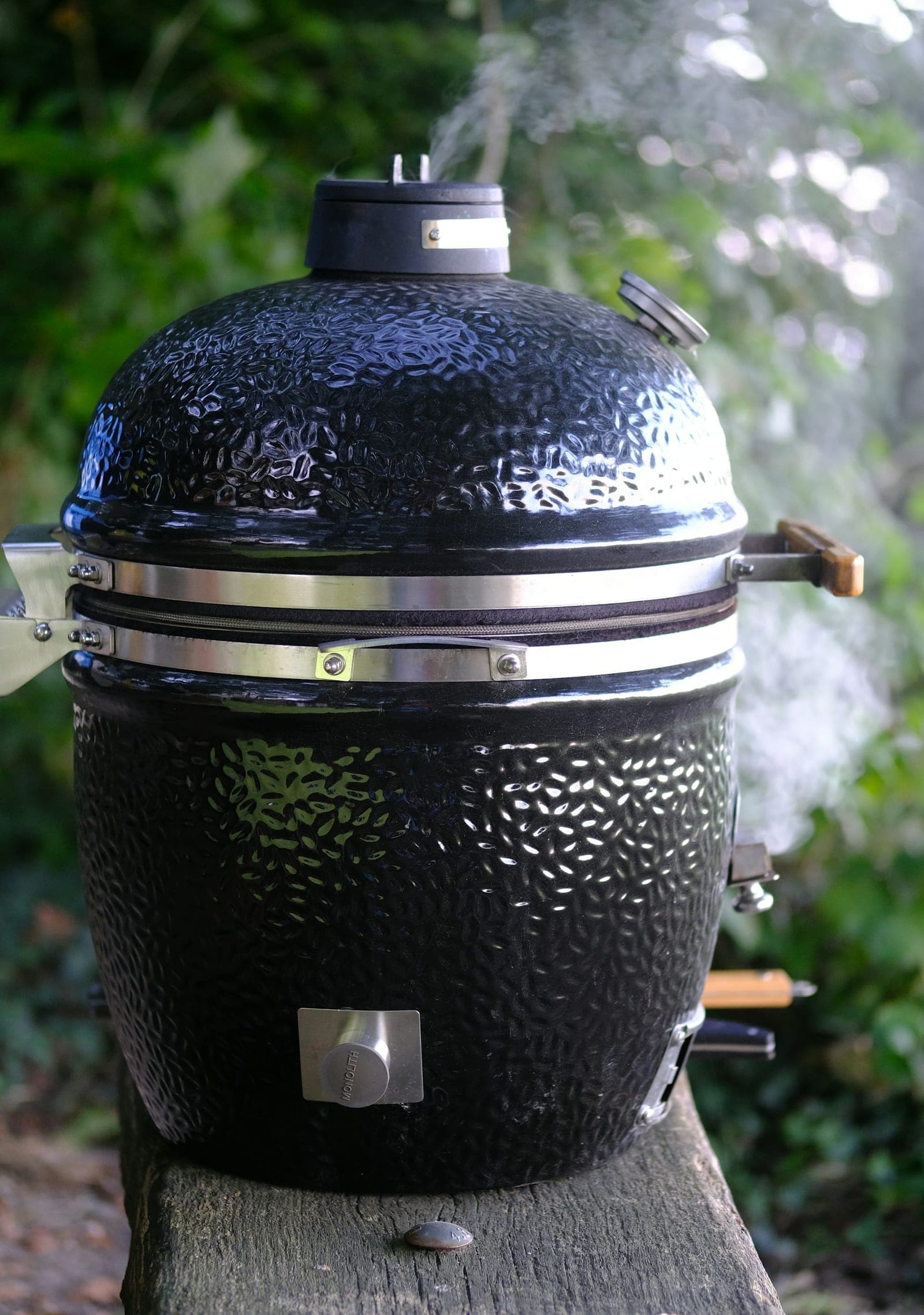
Get the smoker steady at 225–250°F. Any smoker that holds a temperature works: a pellet smoker makes this a set-and-forget affair (see our best pellet smokers comparison), a kamado grill set up for indirect heat will cruise all night on one load of charcoal, and a kettle with a two-zone charcoal setup can absolutely do it with more babysitting. Wait for thin, almost invisible blue smoke; thick white smoke tastes acrid.
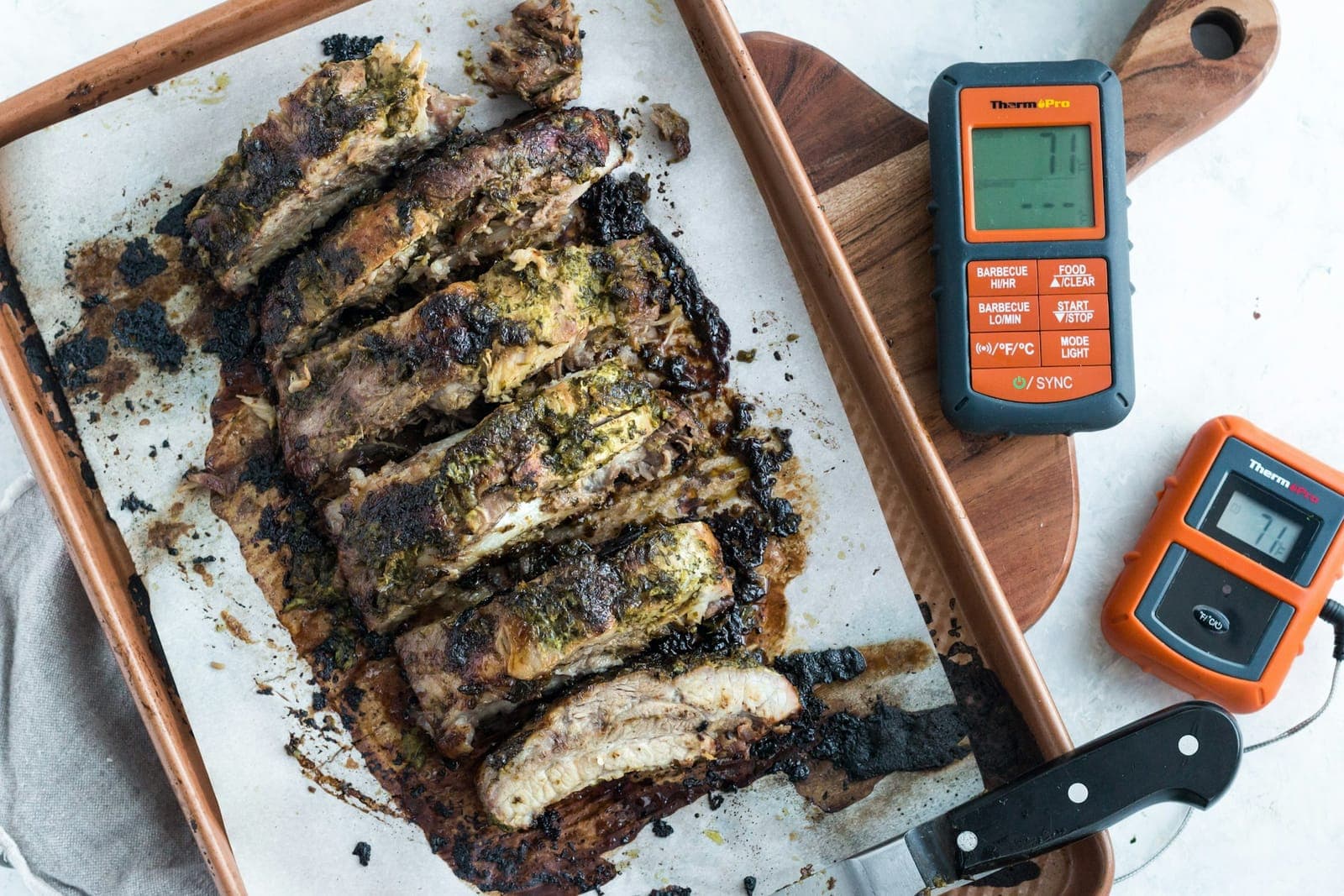
Put the brisket on, fat side toward the heat. On pellet smokers and kamados the fire is below, so that means fat side down; on an offset with heat rolling over the top, fat side up. Aim the thicker point end toward the hotter part of the cooker. Insert a leave-in probe like the ThermoPro TempSpike into the thickest part of the flat; that's the muscle that decides when you're done.
Leave it alone. For the first 3–4 hours, the lid stays closed. Every peek costs you 15–20 minutes of recovery time and gains you nothing. If your smoker runs dry, you can spritz with water every hour after the bark has started to set, but spritzing is optional; lid discipline is not.
Smoke to ~165°F internal and a set bark. Somewhere in the 6–8 hour range the flat will hit the mid-160s. Temperature is only half the test, though; check the bark. It should be deep mahogany-to-black and stay put when you rub it with a (gloved) finger. If it smears like wet rub, give it another hour unwrapped regardless of what the probe says.
Wrap in butcher paper. Lay out two overlapping arm-length sheets of pink butcher paper, set the brisket in the middle, and wrap it tight like a giant burrito: fold, crease, roll. Back on the smoker, seam side down. (More on paper vs. foil below.)
Push to probe-tender, around 203°F. The wrapped stretch takes 3–5 hours. Start checking feel at 198°F: slide an instant-read probe into the thickest part of the flat through the paper. Done brisket offers almost no resistance; the probe glides in like it's going into warm butter. If you feel a rubbery push-back, close the lid and check again in 45 minutes. The number is a guide; the feel is the verdict.
Rest for 1–4 hours. Straight off the smoker, the brisket is a clenched fist of hot juice; slice now and it all ends up on the cutting board. Leave it wrapped, and once the carryover cooking has faded (roughly 30 minutes on the counter), move it into a dry, empty cooler lined with old towels. It will hold above the USDA-safe 140°F for 4+ hours in there. Longer rests, within reason, only make brisket better.
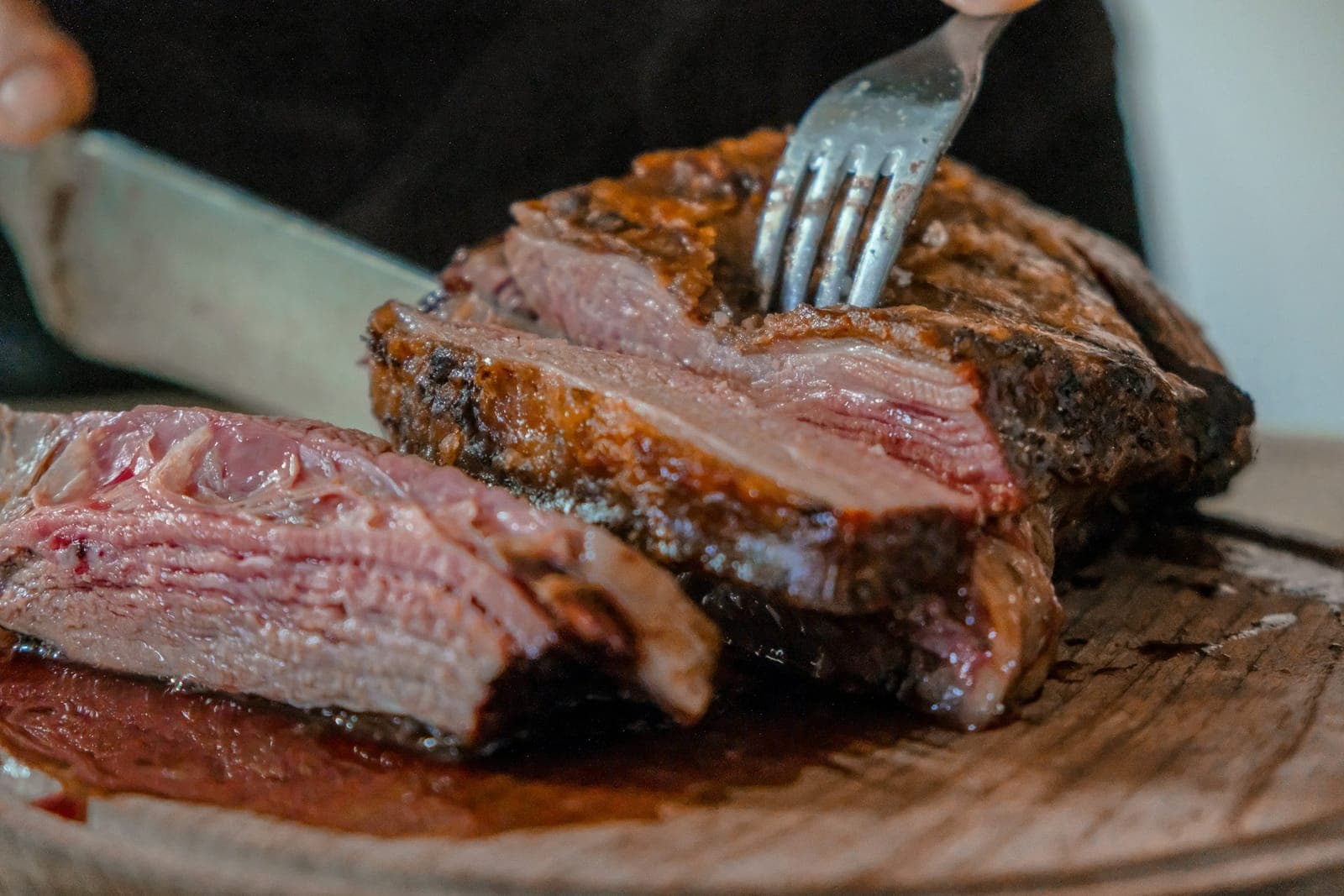
Slice against the grain. Unwrap, save the juices, and slice the flat across its grain in pencil-thick slices. When you reach the point, stop: its grain runs a different direction. Separate the two muscles at the fat seam, rotate the point about 90 degrees, and slice it against its own grain, slightly thicker.
The Stall: Why Your Brisket Stops Cooking
Around hour five or six, your leave-in probe will deliver some alarming news: the brisket has stopped. It hit 155°F, crawled to 157°F, dropped back to 156°F, and has now been parked there for two hours. Nothing is wrong. This is the stall, and it happens to every brisket, every time.
The mechanism is just evaporative cooling, the same reason sweating cools you down. As the meat heats up, moisture pushes to the surface and evaporates, and that evaporation sheds heat about as fast as a 225°F smoker can add it. The two forces fight to a standstill somewhere between 150°F and 170°F, usually for 2–5 hours, until the surface dries out enough for the temperature to climb again.
You have two honest options. Wait it out: the stall is prime bark-building time, and patience yields the best crust. Or wrap, which blocks evaporation and powers through the plateau. What you shouldn't do is panic, crank the smoker to 300°F, or assume your thermometer is broken. The stall isn't a problem to fix; it's a phase to plan for. It's also exactly why wrapping exists.
🌡️ Two thermometers, not one
Serious brisket runs on a pair: a leave-in probe to watch the long arc without opening the lid, and an instant-read to spot-check multiple places and feel for tenderness at the end. Budget versions of both, a ThermoPro TP19H plus a TempSpike, cost under $70 combined. Our meat thermometer comparison covers the full range, and our thermometer guide shows exactly where to probe.
Wrapping: Butcher Paper vs. Foil
Wrapping (the "Texas crutch") speeds the cook through the stall and protects the brisket from drying out in the home stretch. The material you wrap with changes the result more than beginners expect:
- Pink butcher paper: the modern default, popularized by Austin's famous brisket joints. Paper breathes: it lets enough steam escape to keep the bark firm-ish while still pushing through the stall. Slightly slower than foil, and the best balance of bark, speed, and moisture. This is what we'd hand a first-timer.
- Aluminum foil: the fastest route, sealing in all moisture and steam. The cost is bark: foil-wrapped brisket comes out with a softer, wetter crust, and overdone it drifts toward pot roast. A fair choice if you're behind schedule.
- No wrap: the longest cook and the darkest, crunchiest bark. Doable, but it stretches the stall and gives a lean flat more hours to dry out. We'd save it for brisket #3.
One honest note: no wrap decision rescues a brisket that's pulled too early or sliced without resting. Wrapping is a tuning knob, not the difference between success and failure.
The Long Rest (Don't Skip This)
If we could change one thing about how beginners cook brisket, it wouldn't be the rub or the smoker; it would be the rest. An hour is the minimum; 2–4 hours is where brisket gets genuinely better. During the rest, the muscle fibers relax and reabsorb the juices that heat squeezed toward the surface, and the temperature glides down to the ideal 145–160°F slicing range.
The cooler trick makes long rests effortless: leave the brisket in its wrap, add a towel-lined layer in a dry, empty cooler, set the brisket in, and pile more towels on top. A decent cooler holds it above 140°F (the USDA's safe-holding floor) for four hours or more. This is also your scheduling insurance: aim to pull the brisket 2–3 hours before dinner, and an early finish becomes a feature instead of a fire drill.
Slicing Against the Grain
Brisket's last trap is hiding in the cutting board. The flat and the point have grains running roughly 90 degrees apart, so a straight slicing pass down the whole brisket serves half your guests tender beef and the other half rubber bands. Slicing against the grain shortens the muscle fibers so your teeth don't have to.
The sequence: slice the flat across its grain in pencil-width slices (about 1/4 inch). When the round point muscle starts appearing on top of your slices, stop, separate the two muscles along the fat seam, rotate the point about a quarter turn, and slice it against its own grain a touch thicker. A slice should drape over your finger and pull apart with a gentle tug, not fall apart (overcooked), not snap back (undercooked or with the grain).
🔥 Save the point for burnt ends
If a whole sliced brisket is more than your crowd needs, slice only the flat and cube the point into 1-inch chunks. Toss the cubes with a little sauce, pan them, and return them to the smoker for an hour; those are burnt ends, and they may quietly become the reason you smoke your next brisket.
Common First-Brisket Questions
How long does it take to smoke a brisket at 225°F?
Roughly 1 to 1.5 hours per pound at 225–250°F, so a 12–14 lb packer runs 10–14 hours of cook time plus the rest. But treat any per-pound math as a planning tool, not a promise: cook to probe-tender feel, and build slack into your schedule with the cooler hold.
Fat side up or fat side down?
Fat side toward the heat, whatever direction that is on your cooker. Pellet smokers and kamados fire from below: fat side down. Offsets with heat rolling over the top: fat side up. The fat cap is a heat shield, not a self-baster: melting fat runs off the meat, it doesn't soak in.
What internal temp is brisket done?
About 203°F is the famous number, but it's a landmark, not a finish line. Brisket is done when the thickest part of the flat is probe-tender: some get there at 198°F, others need 208°F. (For food safety, whole-muscle beef is technically safe far earlier; the extra hours are purely about converting collagen to gelatin so it's tender enough to enjoy.)
Can I smoke a brisket overnight?
Yes, it's the classic move for an evening meal. Put the brisket on at 10–11 pm at 225°F, let a pellet smoker or well-set kamado hold temp while you sleep, wrap in the morning, and finish by early afternoon with hours of rest to spare. A wireless leave-in probe with an alarm is what makes sleeping through it responsible.
Why did my brisket turn out dry?
Almost always one of four things: a flat-only brisket with no fat insurance, pulling at a number instead of probe-tender feel, a skipped or token rest, or slices cut with the grain. Fix those and dryness mostly disappears: no injection, marinade, or secret spritz required.
Do I need to inject or brine the brisket?
No. Injections are a competition technique for impressing judges with one bite; salt applied the night before does the flavor work for a backyard cook. Master the plain salt-and-pepper version first; it's the version Texas built its reputation on.